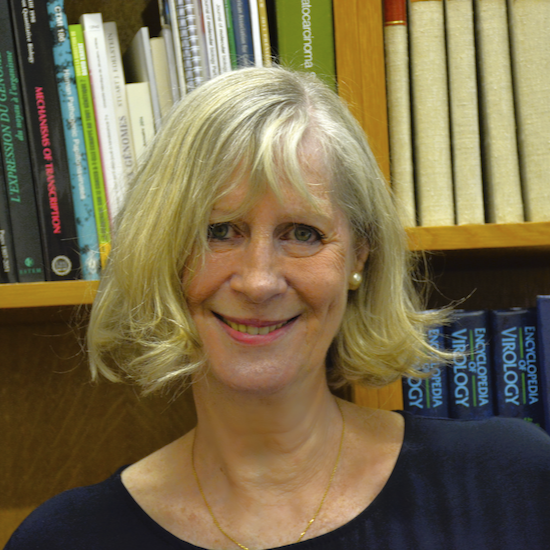
Anne Dejean, PhD
A cancer molecular biologist, Anne Dejean discovered the oncogenic role of altered retinoic acid receptors (RARs) in human cancer, notably liver cancer and acute promyelocytic leukemia (APL). She first identified such a rearrangement in an HBV-associated liver cancer, providing the first evidence that HBV may act as an insertional mutagen. Shortly after, her group discovered that the gene neighboring the HBV integration site encoded a RAR. These studies, marking the first identification of an altered retinoid receptor in a human cancer, proved decisive for her subsequent discoveries on APL. She and colleagues identified the PML-RARα oncoprotein responsible for this form of highly fatal leukemia and made major contributions to understanding the mechanisms underlying both the development of the disease and its cure by retinoic acid and arsenic. Her team demonstrated that nuclear organelles, the PML nuclear bodies, are disrupted in a RA-reversible manner in APL. Therapeutic doses of RA binds the RARα moiety of PML-RARα to release the differentiation block of leukemic cells, while arsenic targets the PML part to trigger SUMOylation-dependent degradation of the oncoprotein. This combined therapy has become a paradigm for two-hit targeted cancer therapy that now cures nearly 90% of patients. She is also renowned for her studies of PML nuclear bodies and the biology of SUMOylation, which identified SUMO as a central epigenetic regulator of cellular identity and innate immunity.
Anne Dejean earned her PhD in 1983 and her habilitation (thèse d’état) in 1988, both from Sorbonne University. She was successively appointed as Assistant Professor (1985–1990), Research Director (1991–2008), Senior Research Director in 2009 at Inserm, and Professor at the Pasteur Institute in 2010. She headed the Nuclear Organisation and Oncogenesis Unit at the Pasteur Institute until December 2025. She is currently Professor Emeritus in the Department of Cell Biology and Infection.
Her scientific contributions have been recognized by numerous awards including the Gagna and Van Heck Prize (2003), the Léopold Griffuel Prize (2010), the L’Oréal-UNESCO for Women in Science Prize (2010), the Grand Prix INSERM (2014), the Sjöberg Prize for Cancer Research (2018), and the Shaw Prize for Life Science and Medicine (2026). She is an Officer of the national order of the Legion of Honour and an elected member of EMBO, the French Academy of Sciences, Academia Europaea, and the American Academy of Arts and Sciences. She was awarded two ERC Advanced Grants, in 2011 and 2018.