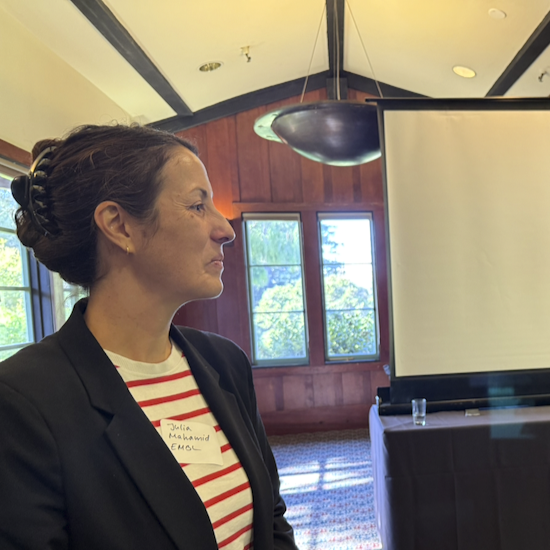
Julia Mahamid, PhD, gives 2026 Kuggie Vallee Distinguished Lecture
The Kuggie Vallee Distinguished Lecture, given by Dr Julia Mahamid, PhD, took place as part of Berkeley’s long-running Monday seminar series jointly organized by the Departments of Molecular and Cell Biology and Chemistry. This series brings together researchers from across campus and regularly features leaders in structural biology, quantitative biology, and related disciplines. Julia Mahamid is one of the world's leading innovators in cryo-electron tomography, a powerful imaging technology that makes it possible to observe the inner workings of cells in three dimensions and at unprecedented resolution. Her work at the European Molecular Biology Laborartory (EMBL) in Heidelberg, has helped transform our ability to study macromolecular assemblies and cellular organization in their natural context, yielding fundamental insights into how cells function in health and disease. Reflecting both the prestige of the lecture and the broad interest in Mahamid’s work, attendance far exceeded expectations – the room was filled to capacity, with a number of attendees having to stand.
Julia gave several compelling examples of how cutting-edge cryo-electron tomography is providing unprecedented insights into the organization and function of living cells. For example, using the genome-reduced human pathogen Mycoplasma pneumoniae as a minimal cell model, the Mahamid lab has established the synergistic application of whole-cell crosslinking mass spectrometry and cellular cryo-ET to determine an in-cell integrative structural model of actively transcribing RNA polymerases coupled to translating ribosomes. Their contributions to computational methods now allow resolving these molecular machines to high resolution, reveal small molecule antibiotics bound to their active site in ribosomes within the intact pathogen, provide snapshots of their structural dynamics, and illuminate functions of previously unknown macromolecular complexes. Such integration of cutting-edge methods unlocks an enormous potential for mechanistic understanding at a system-spanning level by in-cell structural biology. The lecture, which was equally rich in its biological discoveries and technological innovations, highlighted both the power of the methodology and the fundamental questions it can address. The seminar generated extensive discussion and the response was overwhelmingly positive.
The following day, a Women in Science Workshop was attended 28 female postdoctoral researchers and faculty members. The workshop was led by Kay Kostopoulos of Stanford University’s Department of Theatre and Graduate School of Business. Its goal was to help participants develop communication skills that enable them to convey their ideas with confidence, clarity, and impact, competencies that are essential when presenting scientific research at conferences, interviewing for positions, participating in evaluations, and contributing effectively in faculty meetings, among many other professional settings.
The workshop combined presentations, practical exercises, and extensive participant interaction, creating valuable opportunities for learning from both the instructor and one another. The content explored a wide range of topics, from the ways posture, vocal tone, and volume influence how a speaker is perceived and how much credibility they are afforded, to the strategic use of emphasis and delivery to communicate ideas more effectively. The workshop also encouraged participants to reflect on how they perceive others and how they themselves are perceived in professional environments.
Participants were enthusiastic throughout, and their feedback was uniformly positive. Many indicated that the workshop had been highly valuable and that they could readily envision incorporating what they learned into their professional and personal lives. The event provided participants with practical tools that will continue to benefit them throughout their careers.